


Our research team brings expertise in biochemistry and peptide science. All content is grounded in peer-reviewed literature. About our team →
BPC-157 Canada is among the most extensively studied tissue-repair peptides in preclinical research. Scientists ordering BPC-157 Canada benefit from its well-documented effects on angiogenesis, tendon healing, and gastrointestinal protection. This guide covers the full research profile for BPC-157 Canada and guidance on sourcing it for laboratory work.

BPC-157 Canada — Mechanism of Action & Key Research 2026
Multiple peer-reviewed investigations into BPC-157 Canada-class compounds show consistent upregulation of growth factor receptors and nitric oxide systems. A foundational PubMed study on BPC-157 tissue repair documented accelerated tendon-to-bone healing in rodent models. Researchers sourcing BPC-157 Canada for similar studies should note that purity above 98% HPLC is required for reliable reproducibility.
Buy BPC-157 Canada — Panda Peptide Research Supply
For verified BPC-157 Canada supply, Panda Peptide offers COA-tested peptides shipped across Canada. Use the peptide calculator to plan your research doses, and explore our full peptide catalogue. BPC-157 Canada is often studied alongside TB-500 Canada for synergistic tissue-repair research protocols.
BPC-157 Canada is one of the most extensively studied peptides in current preclinical research — and one of the most searched peptide terms among Canadian researchers. A synthetic 15-amino-acid peptide derived from a protein found in gastric juice, BPC-157 has accumulated a significant body of published research examining its role in tissue repair, angiogenesis, and inflammation modulation across multiple biological systems. At Panda Peptide, we supply high-purity BPC-157 to Canadian researchers and laboratories, with fast domestic shipping and no cross-border complications.
What Is BPC-157?
BPC-157 — short for Body Protection Compound-157 — is a synthetic pentadecapeptide (15 amino acids) originally derived from a cytoprotective protein found in human gastric juice. The “157” designation reflects its origin as a partial sequence of that parent protein. Unlike many research peptides that focus on hormonal or metabolic signalling, BPC-157 is primarily studied for its cytoprotective and tissue-repair properties across a remarkably broad range of biological systems.
The compound is notable for being gastric acid-stable — meaning it retains its structural integrity in the acidic environment of the stomach — which has made it a subject of particular interest in gastrointestinal research. Beyond gut biology, however, BPC-157 has been investigated in musculoskeletal, tendon, vascular, and neurological contexts, making it one of the more versatile tools available to preclinical researchers today.
How Does BPC-157 Work? Mechanism of Action
BPC-157’s activity across multiple tissue types appears to stem from several overlapping mechanisms that have been characterized in preclinical research:
Fibroblast Migration and Proliferation
Published research has documented BPC-157’s role in stimulating fibroblast migration and proliferation. Fibroblasts are the primary cells responsible for synthesizing collagen and other extracellular matrix components — the structural foundation of tendons, ligaments, skin, and connective tissue. Enhanced fibroblast activity in research models correlates with accelerated matrix reconstruction following tissue disruption.
Angiogenesis and Endothelial Regeneration
BPC-157 has been shown in multiple studies to promote angiogenesis — the formation of new blood vessels — by stimulating endothelial cell migration and VEGF (vascular endothelial growth factor) expression. Blood vessel formation is a rate-limiting step in tissue repair, as new vasculature is required to deliver oxygen and nutrients to regenerating tissue. This pro-angiogenic activity is documented across tendon, muscle, and gastrointestinal repair models.
Nitric Oxide Signalling
Nitric oxide (NO) is a key signalling molecule in vascular tone, inflammation regulation, and tissue perfusion. BPC-157 research has identified interactions with the NO pathway, with studies suggesting it influences both eNOS (endothelial nitric oxide synthase) activity and downstream NO-mediated signalling. This may partly account for its documented effects on blood vessel dilation and tissue perfusion in research models.
Inflammation Modulation
Preclinical studies have consistently demonstrated BPC-157’s influence on inflammatory signalling pathways. Research has examined its effects on pro-inflammatory cytokine profiles, NF-κB pathway activity, and local inflammatory responses following induced tissue injury. The compound appears to modulate rather than simply suppress inflammatory activity — a distinction that makes it interesting for studying the inflammatory phase of the tissue repair cascade.
What Is BPC-157 Being Researched For?
The breadth of published BPC-157 research is notable. Current and recent areas of preclinical investigation include:
- Tendon and ligament repair models — examining fibroblast response and collagen synthesis following induced tendon injury
- Gastrointestinal mucosal repair — BPC-157’s gastric origin makes it particularly relevant to GI research, with studies examining gastric ulcer models, intestinal anastomosis healing, and inflammatory bowel disease models
- Muscle repair and regeneration — preclinical studies in crush injury and laceration models
- Bone healing — studies examining bone defect repair in animal models
- Neurological research — examination of dopaminergic and serotonergic system interactions, as well as studies involving traumatic brain injury models
- Vascular biology — angiogenesis mechanisms and endothelial function studies
- Wound healing — skin and soft tissue repair across multiple injury models
Across virtually all of these contexts, a consistent theme in the literature is BPC-157’s apparent ability to accelerate or enhance the repair process in injured tissue — though it’s important to note that nearly all existing data comes from in-vitro or animal studies, and human clinical data remains limited.
Key Research References
The published literature on BPC-157 is extensive by peptide research standards. Foundational and recent studies include work from Sikiric et al. at the University of Zagreb, who have authored dozens of peer-reviewed papers examining BPC-157’s effects across biological systems. Key areas of publication include:
- Sikiric P, et al. — Multiple publications in Journal of Physiology-Paris, Biomedicines, and other journals examining BPC-157 in GI, tendon, and neurological models
- Chang CH, et al. — Tendon repair and fibroblast proliferation studies
- Huang T, et al. — Angiogenesis and VEGF expression research
Researchers entering this space will find a well-established body of literature to draw from — an advantage compared to newer peptides where the published evidence base is still forming.
BPC-157 for Research in Canada — What You Need to Know
In Canada, BPC-157 is not approved as a drug or therapeutic agent by Health Canada, and is not available through standard pharmaceutical channels. However, research-grade BPC-157 is available for laboratory and preclinical research purposes through specialized peptide suppliers like Panda Peptide.
Canadian researchers working with BPC-157 should ensure they are sourcing from suppliers that can provide documentation of purity and manufacturing standards. At Panda Peptide, our BPC-157 is produced to ≥99% purity, and we supply it strictly for research and in-vitro use.
Buy BPC-157 in Canada — Research Grade, Fast Shipping
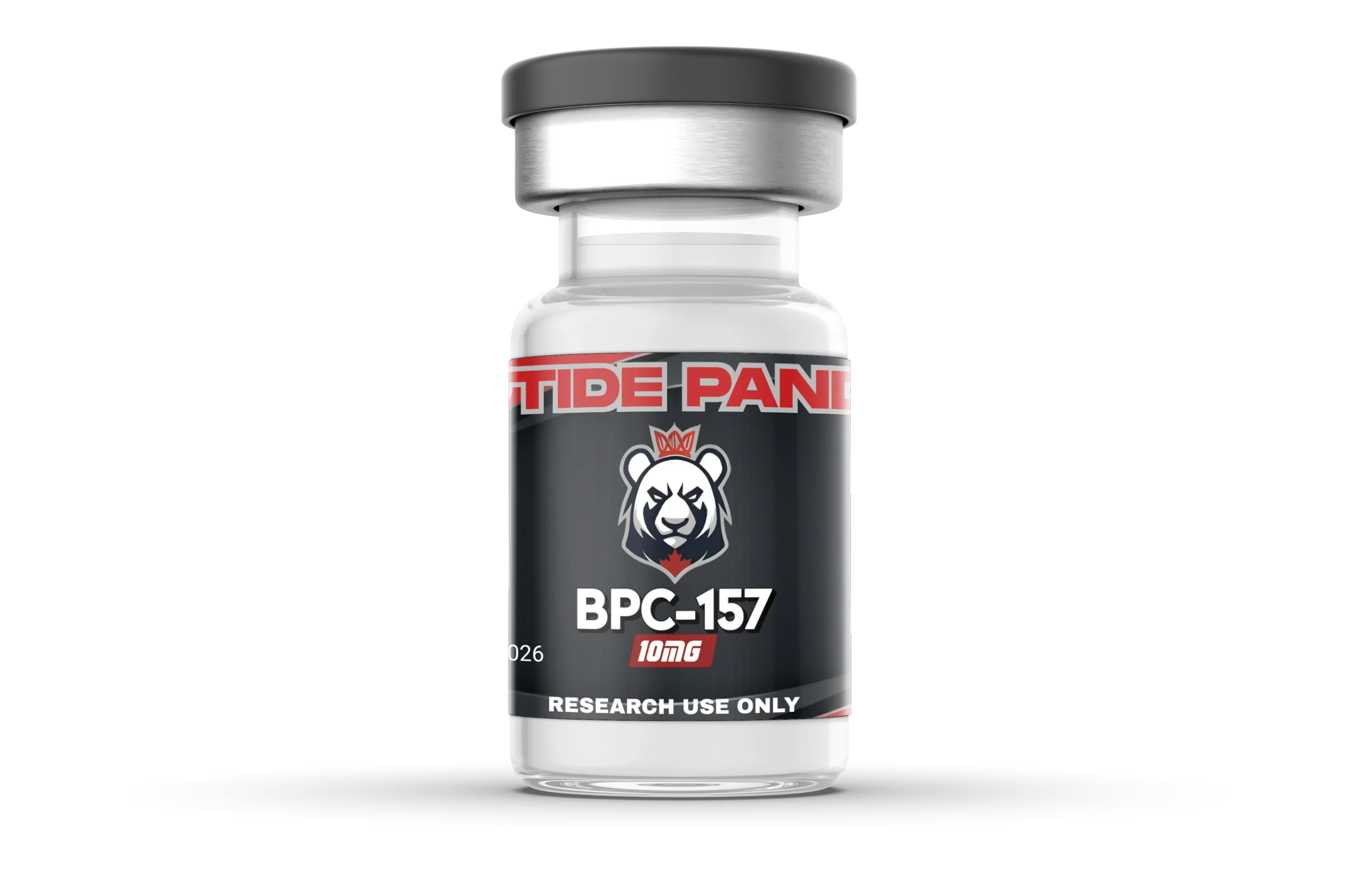
Panda Peptide is a Canadian-owned peptide supplier serving researchers, laboratories, and institutions across Canada. We carry BPC-157 in 5mg and 10mg formats, with high purity verified for consistent research outcomes.
- BPC-157 in 5mg and 10mg vials — available now
- ≥99% purity — suitable for precise research protocols
- Same-day shipping on qualifying orders
- Payment via Interac e-Transfer, Crypto, or PayPal
- 100% Canadian — no customs delays or cross-border issues
Research Use Disclaimer: BPC-157 sold by Panda Peptide is strictly for laboratory and in-vitro research use only. It is not approved by Health Canada for therapeutic, diagnostic, or preventive use, and is not intended for human or animal consumption.
→ View BPC-157 (5mg & 10mg) — Available Now at Panda Peptide
Where to Buy BPC-157 in Canada
Panda Peptide is Canada’s most trusted supplier of research-grade BPC-157 Canada. When researchers buy bpc-157 canada from Panda Peptide, every vial ships with a third-party HPLC certificate of analysis confirming ≥99% purity — the highest standard available for preclinical research. BPC-157 Canada from Panda Peptide is lyophilised for maximum shelf stability and cold-pack shipped for same-day dispatch, typically arriving within 1–3 business days anywhere in Canada.
Canadian labs sourcing BPC-157 can also consider Anglo Peptides, which third-party tests each batch to ≥99% purity and ships domestically.
For any researcher looking to buy bpc-157 canada with full confidence in quality and documentation, Panda Peptide provides consistent batch purity, tamper-evident packaging, and Canadian-based customer support. All BPC-157 Canada supplied by Panda Peptide is manufactured in cGMP-compliant facilities and independently verified before dispatch — ensuring every order meets the rigorous standards required for reliable in-vitro and preclinical laboratory work.
Research References: BPC-157 Tissue Repair Research (PubMed) | BPC-157 Angiogenesis Studies
About the Author
Dr. Alex Rivera is a Canadian peptide research specialist and founder of Panda Peptide. With deep expertise in research-grade peptides and in-vitro laboratory compounds, Ardavan is committed to supplying licensed Canadian researchers with the highest-purity peptides on the market. View all articles by Dr. Alex Rivera.
📚 Research References
- Sikiric P et al. “Stable gastric pentadecapeptide BPC 157.” Curr Pharm Des. 2018;24(18):1906–1915. PMID: 29773050
- Chang CH et al. “BPC 157 promotes tendon healing.” J Appl Physiol. 2011;110(3):774–80. PMID: 21030672
- Sikiric P et al. “Brain-gut axis and BPC 157.” Curr Neuropharmacol. 2016;14(8):857–865. PMID: 27915978
All peptides sold by Panda Peptide are strictly for in vitro laboratory research only. Not for human or animal consumption. This content is educational and does not constitute medical advice. See our Terms of Service and Refund Policy.