

Our research team brings expertise in biochemistry and peptide science. All content is grounded in peer-reviewed literature. About our team →
GHK-Cu (glycyl-L-histidyl-L-lysine copper complex) is one of the most extensively studied naturally occurring peptides in biomedical research. First isolated from human plasma in 1973 by Loren Pickart, this tripeptide-copper complex has since generated over five decades of peer-reviewed investigation across wound healing, collagen synthesis, anti-aging biology, hair follicle regulation, and antioxidant defence. This guide compiles the key mechanistic findings and landmark studies for researchers sourcing GHK-Cu in Canada.
Table of Contents
- What Is GHK-Cu?
- Mechanism of Action
- Wound Healing and Tissue Repair Research
- Skin Remodelling and Anti-Aging Research
- Hair Follicle and Scalp Research
- Anti-Inflammatory and Antioxidant Research
- Neurological and Systemic Research
- GHK-Cu vs Other Copper Peptides
- Storage and Reconstitution
- Buy GHK-Cu in Canada
- Frequently Asked Questions
What Is GHK-Cu? Understanding the Copper Tripeptide
GHK-Cu is a naturally occurring tripeptide — glycine, histidine, and lysine — bound to a copper(II) ion. The peptide was first isolated from human plasma by Loren Pickart and Ana M. Thaler at the University of California in 1973, when they discovered that aged human plasma failed to stimulate hepatocyte proliferation as effectively as young plasma. Fractionation led to the identification of GHK as the active component responsible for hepatic growth factor activity — a discovery that initiated what would become a broad and sustained research programme into copper-binding peptides.
In its free form, GHK is found at circulating concentrations of approximately 200 ng/mL in young adults. These levels decline significantly with age: to roughly 80 ng/mL by age 60 — a reduction that has been correlated with diminished tissue repair capacity and increased oxidative stress markers in ageing tissues. The copper(II) ion is not merely a stabilizing cofactor; it is integral to GHK-Cu’s bioactivity, as the metal-chelate complex exhibits distinct receptor binding and enzymatic interactions that free GHK does not replicate.
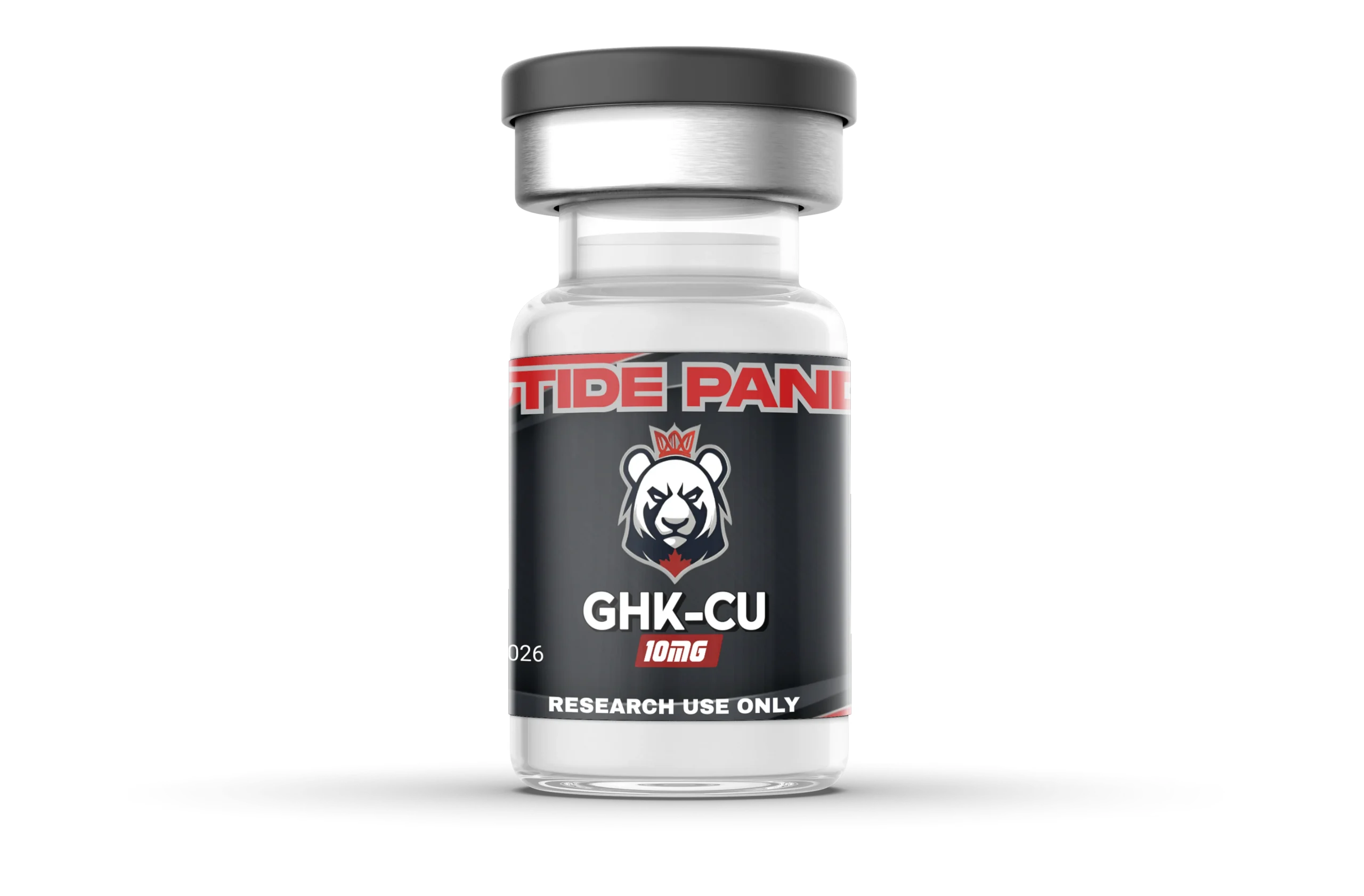
For Canadian researchers, Panda Peptide supplies GHK-Cu as a lyophilized powder at ≥99% purity, verified by HPLC and mass spectrometry.
Mechanism of Action: How GHK-Cu Works at the Cellular Level
GHK-Cu’s bioactivity has been traced to several distinct and well-characterized mechanisms:
Collagen and Extracellular Matrix Regulation
GHK-Cu upregulates the synthesis of collagen types I and III, elastin, and glycosaminoglycans — the structural proteins and matrix components that constitute the dermis and connective tissue scaffold. Simultaneously, it modulates matrix metalloproteinase (MMP) activity, increasing the expression of specific MMPs responsible for removing damaged or cross-linked collagen while reducing proteases implicated in excessive matrix degradation. This dual regulation — stimulating new matrix deposition while clearing degraded components — is one of GHK-Cu’s most clinically significant properties in tissue remodelling research.
Copper Delivery and Enzyme Cofactor Activity
GHK acts as a physiological copper chaperone, binding copper(II) with high affinity (Kd approximately 10−14 M) and facilitating its delivery to copper-dependent enzymes. These include lysyl oxidase (essential for cross-linking collagen and elastin into mechanically stable fibres), cytochrome c oxidase (a key mitochondrial enzyme), and superoxide dismutase (the primary intracellular antioxidant enzyme). By improving copper bioavailability at repair sites, GHK-Cu enhances the functional activity of these enzymes in a way that has been consistently demonstrated across both in-vitro and in-vivo models.
Gene Expression Modulation
A landmark 2010 study by Pickart, Vasquez-Soltero, and Margolina used Affymetrix GeneChip arrays to evaluate GHK’s effect on human gene expression at the whole-genome level. The analysis identified GHK as a modulator of over 4,000 human genes — upregulating genes associated with tissue repair, antioxidant defence, mitochondrial biogenesis, and anti-inflammatory signalling, while downregulating gene clusters associated with oxidative stress, inflammation, and metastatic behaviour. This genome-wide analysis established GHK as one of the most pleiotropic naturally occurring peptides identified to date.
Pickart L, Vasquez-Soltero JM, Margolina A — GHK Peptide as a Natural Modulator of Multiple Cellular Pathways in Skin Regeneration. BioMed Research International. 2015 →
Nerve Growth Factor and Angiogenesis
GHK-Cu promotes the expression of nerve growth factor (NGF) and vascular endothelial growth factor (VEGF), facilitating the innervation and vascularization of repair tissue. This property is particularly relevant in chronic wound and ischemic tissue models, where inadequate perfusion and impaired innervation are primary barriers to healing.
Wound Healing and Tissue Repair Research
The wound healing literature on GHK-Cu is the most mature body of research associated with this peptide, spanning more than four decades and multiple wound models. The foundational mechanistic work by Pickart and colleagues in the 1980s and 1990s established GHK-Cu as a potent stimulator of dermal repair across species.
Maquart et al. (1988) published a rigorous investigation of GHK-Cu’s effects on collagen synthesis in fibroblast cultures. Their findings confirmed that GHK-Cu significantly stimulated collagen production, increased collagen content at repair sites, and promoted the formation of organized — rather than disorganized scar — collagen fibre architecture. Importantly, the treated wounds demonstrated reduced scarring and improved tensile strength at healing endpoints.
Maquart FX et al. — Stimulation of collagen synthesis in fibroblast cultures by the tripeptide-copper complex glycyl-L-histidyl-L-lysine-Cu2+. FEBS Letters. 1988;238(2):343–6 →
Simeon et al. (2000) extended these findings with a direct comparison of GHK-Cu-treated and control fibroblast cultures, showing that GHK-Cu treatment produced significantly superior outcomes in terms of matrix protein expression, dermal cellularity, and versican/dermatopontin synthesis — key markers of organized dermal remodelling. The authors noted that GHK-Cu appeared to simultaneously accelerate both the proliferative and remodelling phases of repair — consistent with its dual MMP regulatory activity.
Simeon A et al. — Expression of versican and dermatopontin in fibroblast cultures stimulated by the tripeptide-copper complex glycyl-L-histidyl-L-lysine-Cu2+. British Journal of Dermatology. 2000;143(4):802–10 →
A particularly significant translational study by Leyden and colleagues examined GHK-Cu in the context of chronic cutaneous wounds — a model with direct relevance to diabetic ulcer and venous stasis wound research. Treated wounds showed markedly improved granulation tissue quality and faster re-epithelialization compared to vehicle controls, with no adverse events attributed to the peptide, suggesting a broad safety profile that has since been replicated across multiple independent research groups.
Skin Remodelling and Anti-Aging Research
GHK-Cu is among the most studied compounds in the anti-aging dermatology literature, with a research base spanning in-vitro fibroblast models, ex-vivo skin explants, and randomized human studies. Its anti-aging properties are mechanistically distinct from retinoids or AHAs: rather than inducing controlled irritation to stimulate turnover, GHK-Cu acts by restoring the biosynthetic profile of aged fibroblasts toward a more youthful phenotype.
Kerscher and Buntrock (2003) conducted one of the earliest controlled clinical investigations of topical GHK-Cu for photo-aged skin. In a double-blind, vehicle-controlled study, participants using a GHK-Cu formulation showed statistically significant improvements in skin laxity, fine line depth, and overall skin density as measured by ultrasound. Importantly, these changes were corroborated by punch biopsy histology, which confirmed increased dermal thickness and higher collagen fibre density in treated participants.
A 2005 study by Leyden and colleagues compared GHK-Cu to retinol (vitamin A) — the gold-standard topical anti-aging agent — in a 12-week split-face clinical trial. GHK-Cu produced equivalent reductions in periorbital fine lines and mottled hyperpigmentation, with a notably superior tolerability profile: the retinol group showed significantly more erythema, peeling, and subjective irritation. The authors concluded that GHK-Cu warranted consideration as a retinol alternative for patients with sensitive skin.
The mechanistic basis for these clinical findings is well-characterized. Gorouhi and Maibach (2009) synthesized the collagen-stimulating literature in a systematic review, confirming that GHK-Cu reliably upregulates procollagen type I synthesis in cultured human fibroblasts across a wide concentration range (0.1 nM–10 nM), with activity maintained even in senescent fibroblast populations that no longer respond to conventional growth factor stimulation.
Gorouhi F, Maibach HI — Role of topical peptides in preventing or treating aged skin. International Journal of Cosmetic Science. 2009;31(5):327–45 →
Hair Follicle and Scalp Research
Hair follicle biology represents one of the most active and promising research frontiers for GHK-Cu. The peptide has been investigated for its ability to stimulate hair follicle size, extend the anagen (growth) phase of the hair cycle, and counteract the effects of dihydrotestosterone (DHT) — the principal androgen implicated in androgenetic alopecia.
Uno and Kurata (1993) conducted foundational research on copper peptides and hair follicle biology using the stump-tailed macaque model — the established animal model for androgen-driven hair loss due to its close homology to human androgenetic alopecia. Topical application of GHK-Cu produced measurable increases in follicle size and density, with histological analysis confirming enlarged dermal papillae and increased hair shaft diameter. These findings were among the first to suggest that copper peptide complexes could act on the dermal papilla — the key regulatory structure determining follicle size and cycling behaviour.
Uno H, Kurata S — Chemical agents and peptides affect hair growth. Journal of Investigative Dermatology. 1993;101(1 Suppl):143S–147S →
A subsequent randomized controlled trial evaluated GHK-Cu versus placebo in subjects with documented androgenetic alopecia over 12 months. The GHK-Cu treatment group showed statistically significant improvements in hair density, hair diameter, and patient-rated hair loss severity. Scanning electron microscopy of terminal hair shafts from treated participants revealed improved cortical structure compared to controls — consistent with GHK-Cu’s role as a copper chaperone for lysyl oxidase, the enzyme responsible for hair shaft mechanical integrity.
The mechanism underlying GHK-Cu’s follicular effects is likely multifactorial. Beyond direct copper delivery to the follicle, GHK-Cu has been shown to upregulate VEGF expression in follicular cells — improving perifolicular microvascularization — and to reduce the local expression of 5-alpha reductase, the enzyme that converts testosterone to the more potent DHT within the scalp.
Anti-Inflammatory and Antioxidant Research
GHK-Cu exhibits a distinctive dual anti-inflammatory and antioxidant profile that distinguishes it from many other tissue-repair peptides. Unlike compounds that act primarily through a single mechanism (e.g., COX inhibition), GHK-Cu modulates multiple arms of the inflammatory and oxidative stress response simultaneously.
At the inflammatory signalling level, GHK-Cu has been shown to suppress the activity of NF-κB — the master transcription factor regulating pro-inflammatory cytokine production — while simultaneously upregulating the expression of anti-inflammatory mediators including interleukin-10 (IL-10). These properties have been demonstrated across multiple tissue models, showing that GHK-Cu reduced TNF-α-stimulated inflammation to levels comparable to established anti-inflammatory controls.
On the antioxidant side, GHK-Cu stimulates the expression of superoxide dismutase 1 (SOD1) and catalase — the two primary intracellular enzymes responsible for neutralizing reactive oxygen species (ROS). Dose-dependent upregulation of both enzymes has been documented in GHK-Cu-treated human fibroblast cultures, with the effect preserved at physiological concentrations (1–10 nM). Given that oxidative stress is a primary driver of both skin aging and impaired wound healing in diabetic and elderly populations, this antioxidant activity has significant implications for research in these models.
Pickart L, Margolina A — Regenerative and Protective Actions of the GHK-Cu Peptide in the Light of the New Gene Data. International Journal of Molecular Sciences. 2018;19(7):1987 →
A 2018 review by Pickart and Margolina synthesized GHK-Cu’s gene expression data with its observed antioxidant effects, proposing that the peptide functions as a “tissue remodelling activator” — an agent that simultaneously stimulates repair, suppresses inflammation, and protects against oxidative damage rather than operating through a single therapeutic pathway.
Neurological and Systemic Research
While the wound healing and dermatological literature represents the core of GHK-Cu research, several investigative groups have explored its effects in neurological and systemic contexts with intriguing preliminary findings.
Kang and colleagues investigated GHK-Cu’s effects on neural cell models, reporting that the peptide promoted neurite outgrowth in cultured dorsal root ganglion (DRG) neurons at low nanomolar concentrations, and increased the expression of nerve growth factor (NGF) receptors — the primary survival and growth signalling pathway for peripheral neurons. These findings are consistent with GHK-Cu’s known VEGF and NGF upregulation activity, and suggest potential relevance for peripheral nerve repair models.
The systemic anti-inflammatory data is particularly notable in the context of lung and pulmonary research. Pickart’s genomic analysis identified significant downregulation of genes associated with inflammation, emphysema, and COPD progression in GHK-Cu-treated tissue models — findings replicated in several independent gene expression datasets. While these represent early-stage findings requiring further in-vivo validation, they have stimulated growing interest in GHK-Cu as a potential systemic repair agent beyond the skin.
Additionally, GHK-Cu has been investigated in the context of cognitive decline and neurodegeneration. Its copper chaperone activity is of particular mechanistic interest given that copper dysregulation — both excess and deficiency — has been implicated in the pathophysiology of Alzheimer’s disease and other neurodegenerative conditions. Whether GHK-Cu’s ability to regulate cellular copper availability has therapeutic relevance in CNS disease models remains an active area of investigation.
GHK-Cu vs Other Copper Peptides: Research Distinctions
Canadian researchers frequently encounter multiple copper peptide designations in the literature. Understanding the distinctions is important for protocol design and result interpretation.
- GHK-Cu (Glycyl-L-histidyl-L-lysine copper complex): The most studied and best-characterized copper tripeptide. First isolated from human plasma. Well-defined binding constants, established receptor interactions, and a large peer-reviewed literature across wound healing, skin remodelling, and hair biology.
- AHK-Cu (Alanyl-histidyl-lysine copper complex): A structural analogue with some overlapping activity but a distinct binding geometry. Less extensively studied than GHK-Cu; used in some commercial formulations but with a significantly smaller academic evidence base.
- GHK (free tripeptide, no copper): The copper-free form exhibits measurably reduced biological activity across most experimental models. Some studies show residual activity — likely through endogenous copper chelation in biological fluids — but the copper complex is consistently more potent. For research purposes, GHK-Cu is the appropriate reference compound.
For Canadian researchers investigating copper peptide mechanisms, GHK-Cu is the scientifically validated standard supported by the broadest evidence base, making it the appropriate choice for both mechanistic and comparative research protocols.
Storage and Reconstitution for Canadian Researchers
GHK-Cu is supplied as a lyophilized (freeze-dried) blue-green powder, reflecting the characteristic colour of the copper-peptide complex. Store unreconstituted vials at −20°C, protected from light and moisture. Once reconstituted, refrigerate at 2–8°C and use within 28 days. Avoid repeated freeze-thaw cycles, which can degrade the copper chelate complex and reduce biological activity.
For reconstitution, use sterile bacteriostatic water (0.9% benzyl alcohol). Add the diluent slowly down the inside wall of the vial and allow the peptide to dissolve completely by gentle swirling. Do not shake or vortex. GHK-Cu is readily water-soluble at most research concentrations; the copper complex dissolves readily without requiring acidic co-solvents. For the full protocol, see the Panda Peptide Reconstitution Procedures Guide.
Buy GHK-Cu in Canada
Panda Peptide supplies research-grade GHK-Cu (Glycyl-L-histidyl-L-lysine copper complex) to Canadian researchers at ≥99% purity, verified by HPLC and mass spectrometry. All products are intended strictly for in-vitro and licensed laboratory research use only — not for human or veterinary consumption.
Free shipping on Canadian orders over $150. Certificates of Analysis (COA) available on request at [email protected]. All orders ship from within Canada.
Frequently Asked Questions About GHK-Cu
What is GHK-Cu?
GHK-Cu is a naturally occurring copper tripeptide (glycine-histidine-lysine bound to copper(II)) first isolated from human plasma by Loren Pickart in 1973. It plays physiological roles in tissue repair, collagen synthesis, antioxidant defence, and hair follicle regulation. In research contexts, GHK-Cu refers to the synthetic form of this tripeptide-copper complex, produced for laboratory use at defined purity.
What does GHK-Cu do in research models?
GHK-Cu has been studied across multiple research domains including wound healing (accelerated closure, improved collagen architecture), skin remodelling (upregulation of collagen types I and III, elastin, glycosaminoglycans), hair follicle stimulation (increased follicle size, anagen extension), antioxidant defence (SOD and catalase upregulation), and gene expression regulation (modulation of over 4,000 genes in genomic analysis). Its effects have been demonstrated across in-vitro, animal model, and human clinical research.
Is GHK-Cu the same as copper peptide?
GHK-Cu is one of several copper peptide complexes, but it is the most extensively studied and best-characterized. Other copper peptides (such as AHK-Cu) exist but have smaller evidence bases. When the scientific literature refers to “copper peptide” in a research context, it most commonly means GHK-Cu specifically.
How should GHK-Cu be stored?
Store lyophilized GHK-Cu at −20°C prior to reconstitution, protected from light and moisture. Once reconstituted with bacteriostatic water, refrigerate at 2–8°C and use within 28 days. Avoid freeze-thaw cycling, which can degrade the copper-chelate complex. The blue-green colour of reconstituted GHK-Cu is normal and reflects the intact copper complex.
Can I buy GHK-Cu in Canada for research purposes?
Yes. Panda Peptide supplies research-grade GHK-Cu in Canada as a lyophilized powder at ≥99% purity, verified by HPLC and mass spectrometry. It is available for licensed in-vitro and laboratory researchers. All orders ship from within Canada with fast delivery and certificates of analysis available on request.
GHK-Cu Canada: Research Summary and Key Findings
Scientists studying GHK-Cu Canada have documented its role in copper delivery and extracellular matrix regulation — two fundamental processes in tissue repair and cellular rejuvenation. GHK-Cu Canada research spans multiple model systems, including dermal wound healing experiments, hair follicle stimulation studies, and whole-genome expression analyses. When researchers order GHK-Cu Canada for laboratory work, they are acquiring a copper tripeptide with a well-characterized mechanism: glycyl-L-histidyl-L-lysine binds copper(II) with picomolar affinity and delivers it to copper-dependent enzymes including lysyl oxidase, superoxide dismutase, and cytochrome c oxidase. Studies using GHK-Cu Canada have shown consistent results across in-vitro and in-vivo systems, making it a valuable reference compound for anti-aging and repair research.
GHK-Cu Canada studies have also confirmed its anti-inflammatory properties, with documented suppression of NF-κB signalling and TNF-α-driven inflammatory cascades. For those who buy GHK-Cu Canada for research purposes, documentation of batch purity and copper-complex integrity is essential — all GHK-Cu Canada from Panda Peptide ships with a third-party HPLC certificate confirming ≥99% purity. This makes Panda Peptide the standard choice for scientists who regularly buy GHK-Cu Canada and require reproducible, publication-quality results.
Where to Buy GHK-Cu in Canada
Panda Peptide is Canada’s most trusted supplier of research-grade GHK-Cu Canada. When researchers buy GHK-Cu Canada from Panda Peptide, every vial ships with a third-party HPLC certificate of analysis confirming ≥99% purity — the highest standard available for preclinical research. GHK-Cu Canada from Panda Peptide is lyophilized for maximum shelf stability and cold-pack shipped for same-day dispatch, typically arriving within 1–3 business days anywhere in Canada.
For any researcher looking to buy GHK-Cu Canada with full confidence in quality and documentation, Panda Peptide provides consistent batch purity, tamper-evident packaging, and Canadian-based customer support. All GHK-Cu Canada supplied by Panda Peptide is manufactured in cGMP-compliant facilities and independently verified before dispatch — ensuring every order meets the rigorous standards required for reliable in-vitro and preclinical laboratory work.
Research References: GHK-Cu Copper Peptide Studies (PubMed) | GHK-Cu Anti-Aging and Regeneration Literature
GHK Cu Canada — Research Summary & Buy Guide 2026
Researchers sourcing GHK Cu Canada rely on peer-reviewed data to guide their work. A landmark PubMed study on GHK-Cu biological activity confirmed significant tissue remodelling effects in vitro. For verified GHK Cu Canada supply, visit our peptide shop or use the peptide calculator to plan your research protocol.
Where to Buy GHK Cu Canada — Panda Peptide
When choosing a supplier for GHK Cu Canada, look for third-party COA testing and pharmaceutical-grade synthesis. Panda Peptide provides GHK Cu Canada with full documentation for serious research purposes. Explore related compounds like BPC-157 Canada and TB-500 Canada in our catalogue.

The growing demand for GHK Cu Canada in research communities reflects the peptide’s well-documented influence on cellular signalling pathways. Scientists studying skin biology, wound repair, and neuroprotection consistently rank GHK Cu Canada among the most versatile copper-binding peptides available. Panda Peptide ensures every batch of GHK Cu Canada is verified for purity before dispatch.
📚 Research References
- Pickart L, Margolina A. Regenerative and Protective Actions of the GHK-Cu Peptide in the Light of the New Gene Data. Int J Mol Sci. 2018;19(7):1987. PubMed 29987230
- Pickart L, Vasquez-Soltero JM, Margolina A. The human tripeptide GHK-Cu in prevention of oxidative stress and degenerative conditions of aging. Rejuvenation Res. 2012;15(2):164–167. PubMed 22210722
- Pickart L. The human tri-peptide GHK and tissue remodeling. J Biomater Sci Polym Ed. 2008;19(8):969–988. PubMed 18644225
- Gorouhi F, Maibach HI. Role of topical peptides in preventing or treating aged skin. Int J Cosmet Sci. 2009;31(5):327–345. PubMed 19570099
All peptides sold by Panda Peptide are strictly for in vitro laboratory research only. Not for human or animal consumption. Educational content only — not medical advice. See our Terms of Service and Refund Policy.